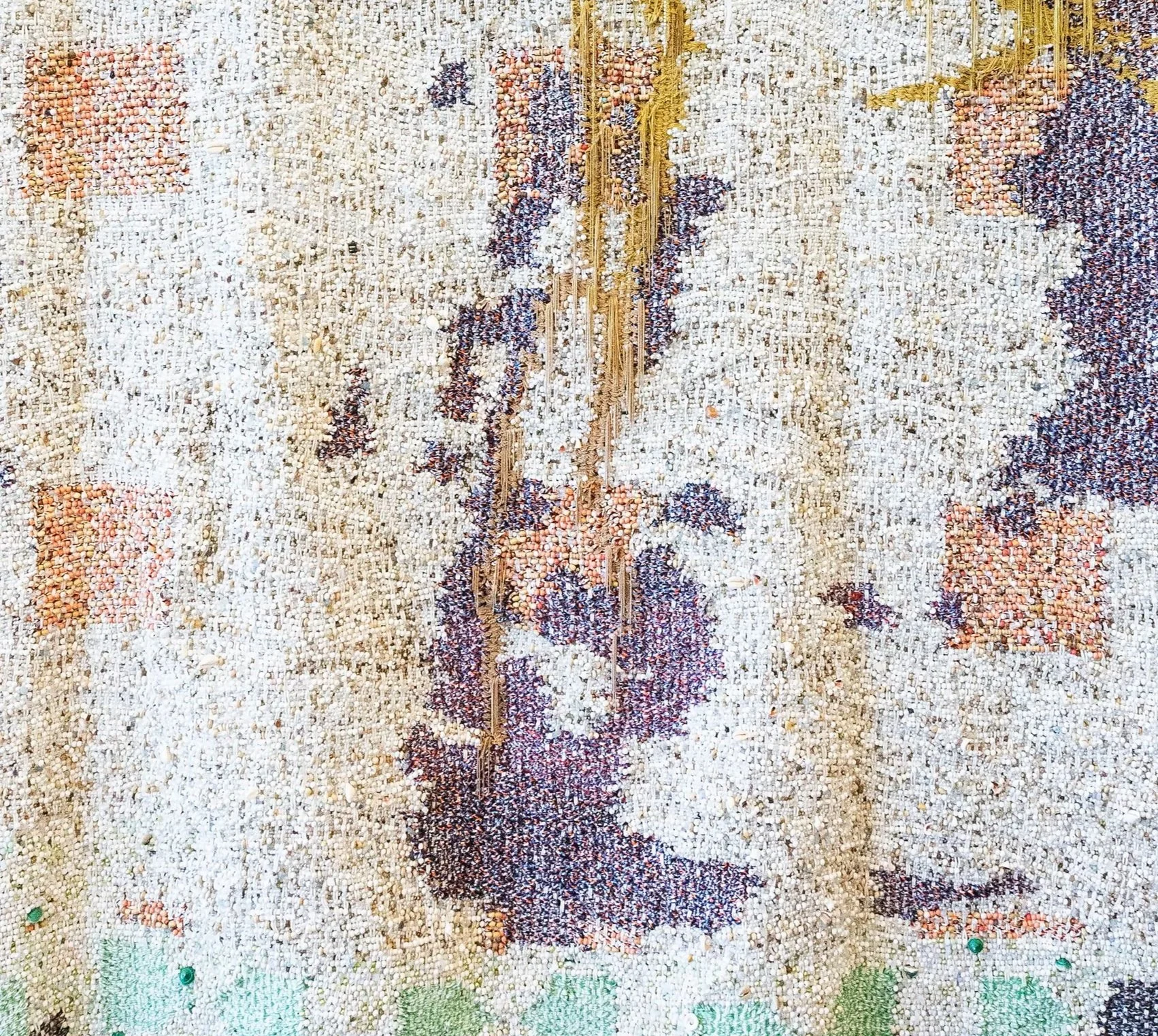
Duister Omsingel
2021
Wood, plastic, stone, glass and shell beads, polyester and nylon rope, chain, cotton twine
88.5 × 69 in
Igshaan Adams (b. 1982) was born in Cape Town, South Africa. In his tapestries and textile installations, Adams engages with the gaps—the information that is seemingly absent, overlooked or rendered invisible in the spaces we inhabit individually and collectively. Through the beads, shells, glass, rope, wire and found objects he uses to compose his weavings, Adams highlights the material aspects of lived spaces along with the personal stories held within them.
Adams’s hometown, Bonteheuwel, South Africa, is a key source of inspiration. This predominantly working-class township in southeast Cape Town was founded in the 1960s as part of the forced segregation during the Apartheid era. Adams approaches Bonteheuwel both as a deeply personal space, imbued with childhood memories and a network of familial relationships, and a politically charged space, shaped by violence and generational trauma. Neither can erase the other; both are always present.
Rules and Cylinders
2012
Bronze
97 x 73 × 9 in
Donald Baechler (b. 1956, Hartford, Connecticut) is an American artist. He attended the Maryland Institute College of Art from 1974–1977, and the Cooper Union from 1977–1978. Baechler's source material draws broadly on classical art history, the New York School, contemporary art, folk art, outsider art, pop culture and childhood. Baechler's creative process begins amidst a vast collection of popular images and objects, the archives of years of photographing, looking and gathering. His paintings are condensed versions of that cumulative process, built in fragments and layers to create what he calls an "illusion of history." The artist cites Cy Twombly and Giotto as his primary influences.
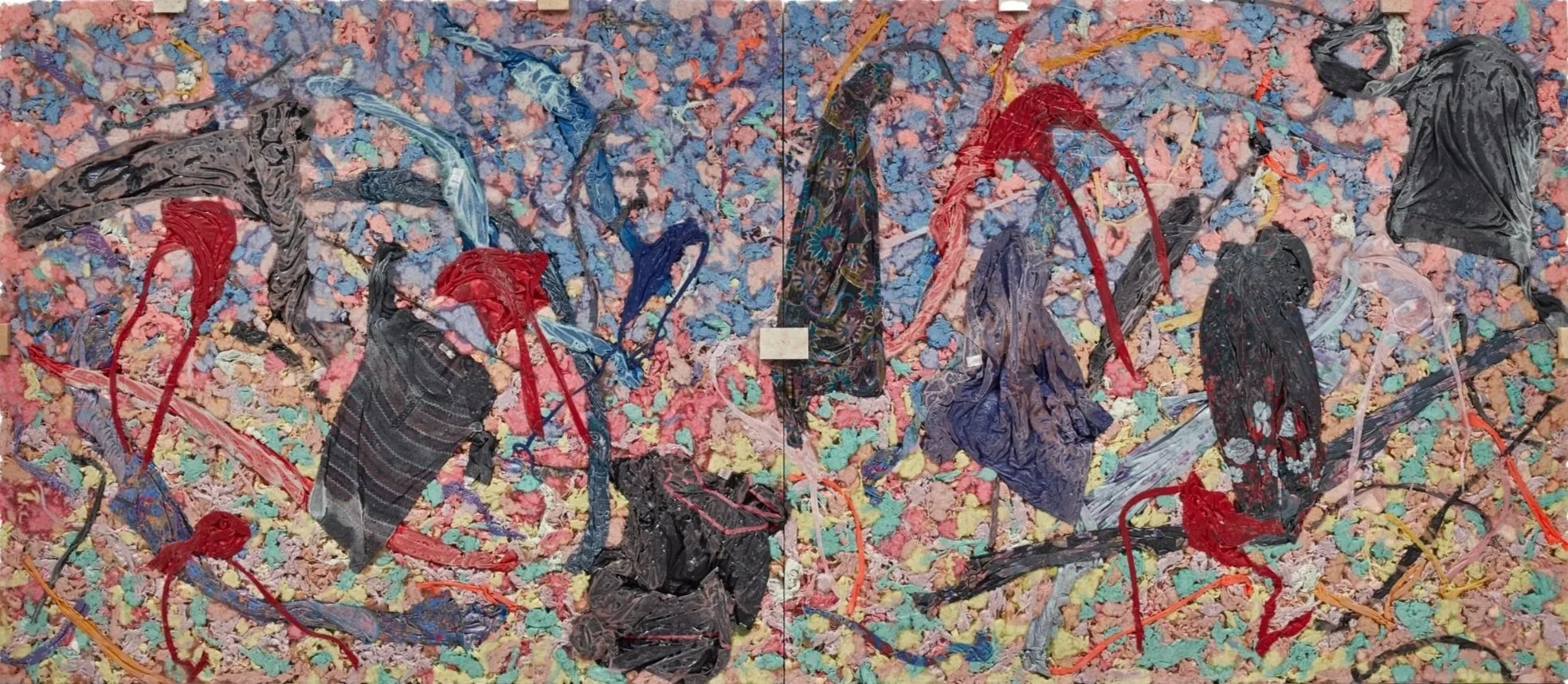
The Dance
2019
Polyurethane resin, raw Virginia cotton, housedresses, kaftans, t-shirts, du-rags, altered housedresses, altered kaftans, altered t-shirts, altered garments, and stainless steel fasteners
77.5 × 180 in
Beasley is known for sculpture that incorporates found materials–especially clothing–and casting materials like resin and foam. While these materials cure or set into their final state, Beasley works them with his body, a process that points to his interest in sculpture that traces of the artist's body while retaining a bodily, fleshy quality of its own. Many of his sculptures also contain audio equipment or are used in sound-based installations or performances.
For Beasley, cotton is not just a material, it is a theme that touches on politics, social relationships, and of course, economics and reparations. “It all just unfolds and is laid out,” he says. At his show at the Whitney, Beasley constructed a series of sculptural works, comprised of various materials, that he calls “slabs.” He says: “They become ways of telling stories.” In his works, Beasley takes control over not just a material, but the systemic repression of Black people and artists, to construct something new.
“Being a Black person in this current state, that’s what you’re encouraged to do—is to move on. Like, ‘Ok, there’s been time. There’s been space,’ right? It’s a false narrative. But it also is one that you feel the pressure from.”
The Dance is a two sided piece.
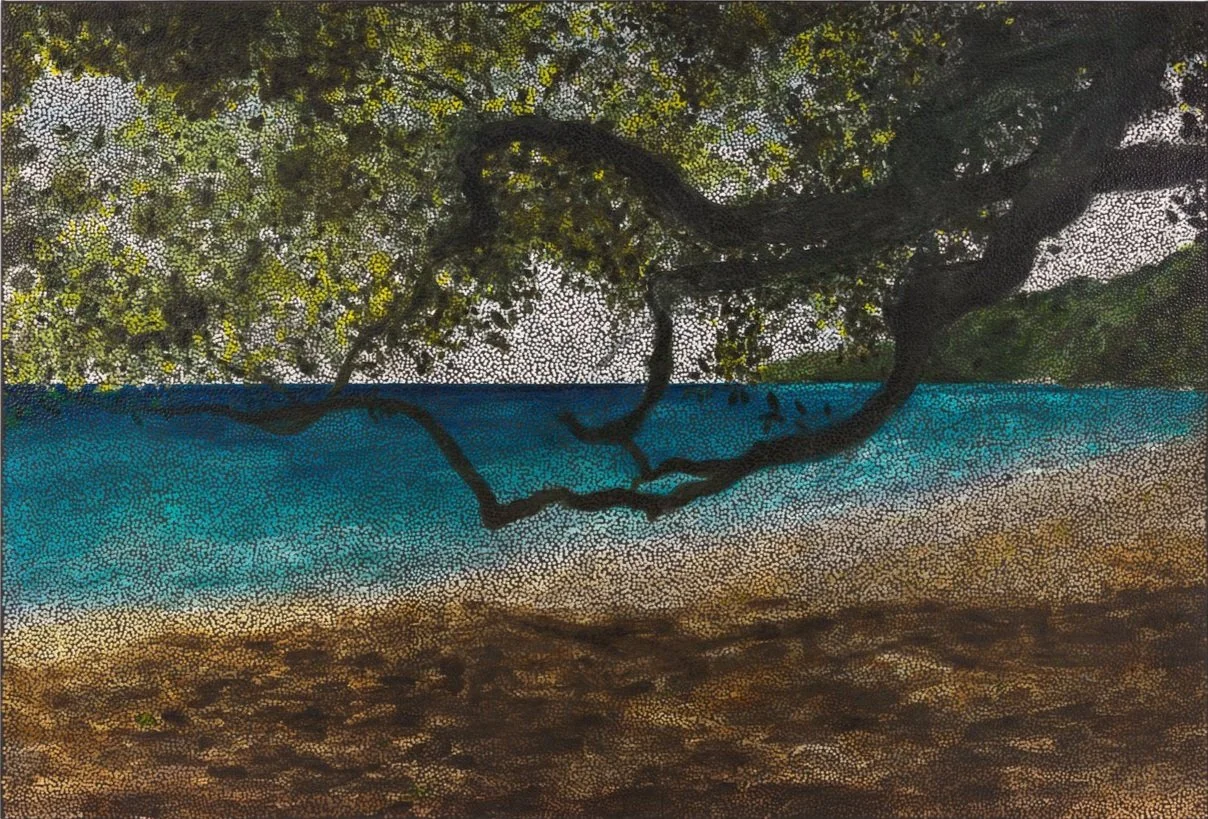
Untitled (SPCFFATS)
2023
Oil, acrylic and archival glue on canvas
66.875 × 98.375 in
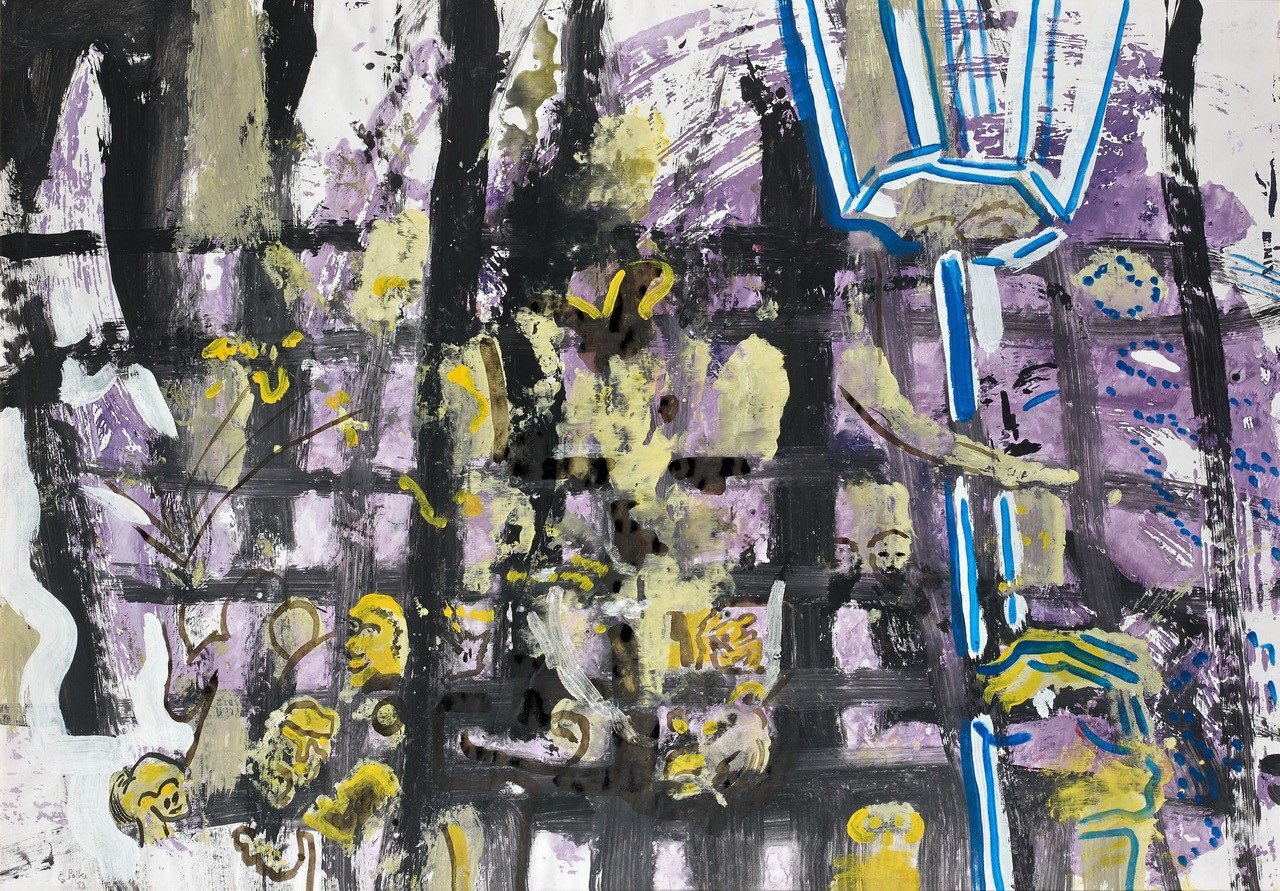
Born in Cairns in 1982, the Sydney-based artist studied at the Australian National University’s School of Art and Design in Canberra. Of Kudjala, Gangalu, Wangerriburra, Wakka Wakka, Gubbi Gubbi, Kuku Yalanji, Bundjalung, and ni-Vanuatu heritage, Boyd has described how his great-great-grandfather was kidnapped from Pentecost Island in Vanuatu and enslaved on Queensland’s sugar-cane fields. His grandparents were part of Australia’s Stolen Generations, in which First Nations children were forcibly removed from their families as part of the government’s policy of assimilation from 1910 to the 1970s.
This history makes its way into Boyd’s work through the use of personal photographs, memories, archival imagery, and historic portraits as sources for his paintings, which are covered with translucent, reflective dots of archival glue. ‘Even though the visual language is reminiscent to the First Nations of Central Australia, I actually don’t have a connection to that part of the country,’ the artist explains. The use of these dots, or ‘lenses’, as Boyd refers to them, is a signature of his work and employed across installations, moving images, and paintings. ‘For me the circle acts as a lens, so it’s about perception and multiple entry points into specific ideas of things that I wanted to work through’, Boyd explains.
Excerpt courtesy of post-ism
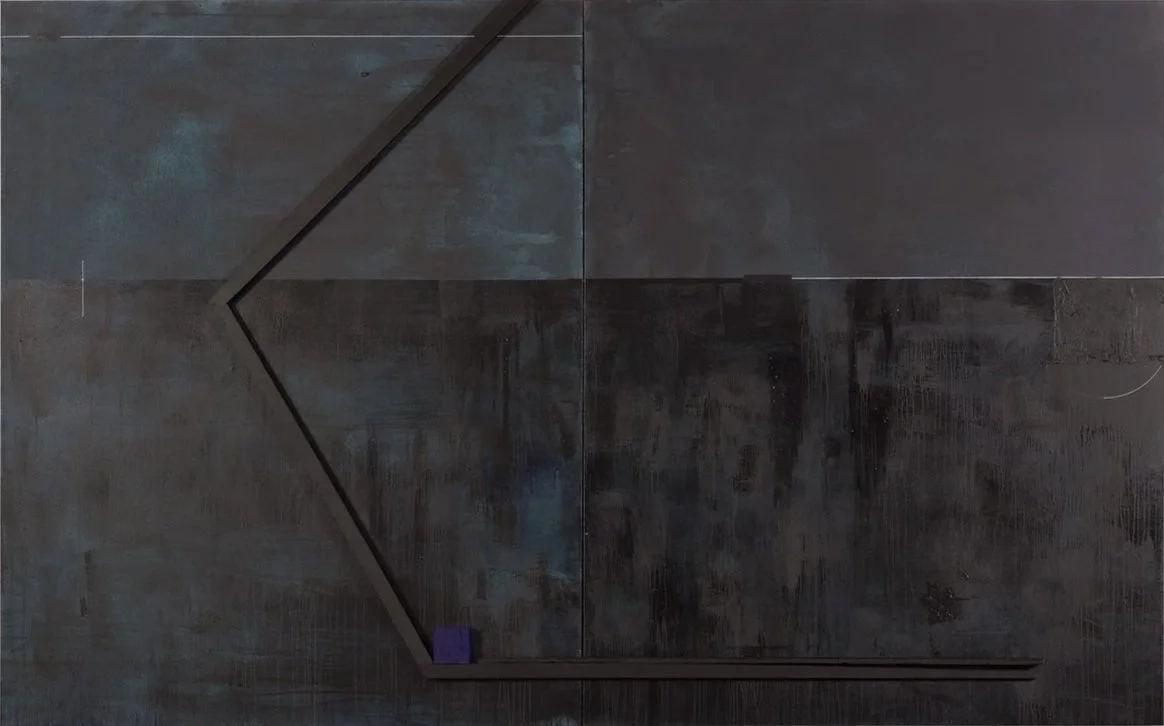
Below, Becoming, Belonging (Systems in the Dark)
2022
Acrylic, wood, ink and glass on canvas
101.5 × 160 × 6 in
Dyson, who was born in Chicago and is now based in Beacon, New York, is known for a wide-ranging practice that is grounded in painting but extends to sculpture, installation, and performance. Her work is concerned with examining the structures and infrastructures of society, particularly the ways in which those systems have historically controlled the movements of Black and brown people, as a way to envision new spaces for liberation.
In a statement, Dyson said, “Every move, every step—I am always thinking about and imagining all of the spaces where people, Black people in particular, headed toward and moved to save themselves. With different geographies, there are different elevations to deal with. Chicago has personal meaning to me and is also fertile ground for my ongoing research and studio practice into water and spatial liberation.”
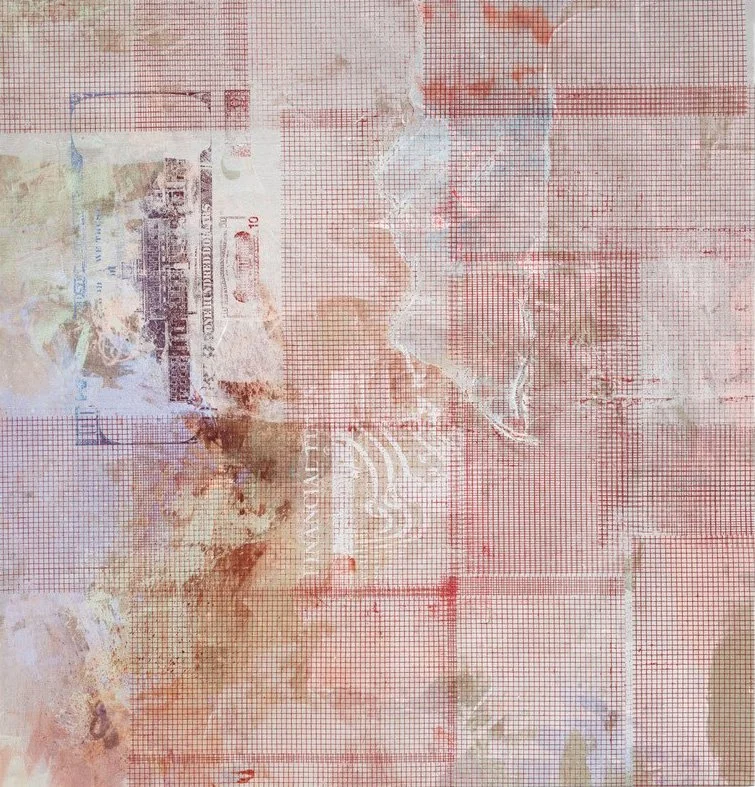
Net-Grid (waves and washes)
2023
Oil and acrylic on linen with collaged and silkscreened elements
92.5 x 88.5 in
Mandy El-Sayegh’s process-driven practice investigates systems of order, be they linguistic, bodily, political, or other. She combines unexpected imagery using silkscreen, painting, and collage to create heavily layered canvases. El-Sayegh begins each piece with found fragments, such as clippings collected from newspapers, advertisements, and notebooks. She then, in her words, “sutures” these parts together on the canvas, superimposing disparate materials to construct new narratives. She often incorporates pages from the Financial Times, due to its subject matter and flesh-like color. In her ongoing “Net-grid” series, she paints grids over silkscreened layers that are meant to symbolize the limitations and confines of language.
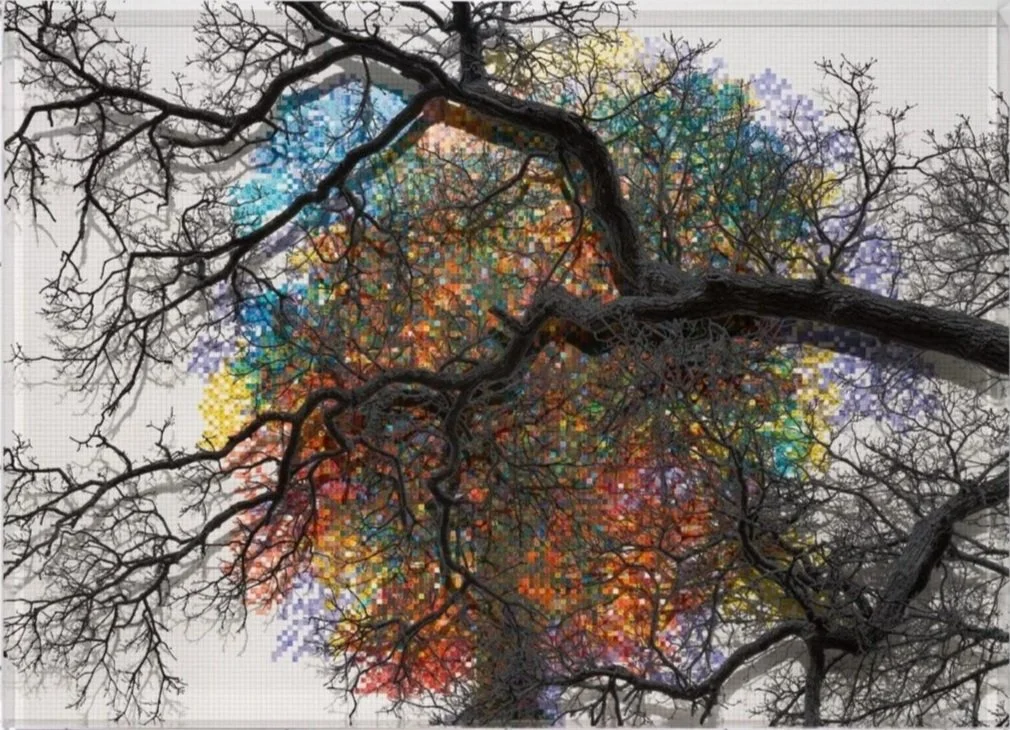
Numbers and Trees, Central Park, Series I: Tree #2
2015
Acrylic, inkjet print, plexiglass
95 x 126.5 x 5.75 in
Numbers and Trees: London Series 2, Tree #8, Vine Street
2022
Acrylic sheet, acrylic paint, lacquer, and wood
60 × 82.75 x 5.75 in
Charles Gaines (b. 1944, Charleston, South Carolina) is an American artist whose work interrogates the discourse relating aesthetics and politics. Taking the form of drawings, photographic series and video installations, his work consistently invokes the use of systems as generative parts of the artist’s practice. His work is rooted in Conceptual Art, and he is committed to its tenets of engaging cognition and language. There is a strong musical thread running though much of Gaines’ work, evident in his repeated use of musical scores as well as his engagement with the idea of indeterminacy as developed by John Cage.
Untitled
2003
Gouache on paper
Dimensions vary
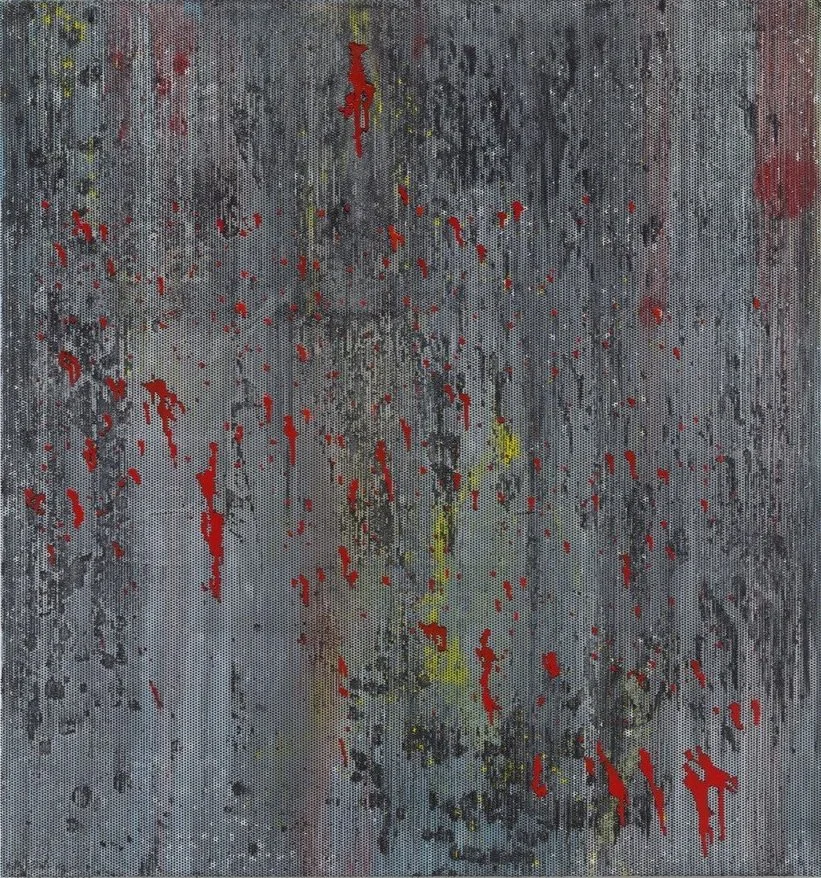
(series of emojis) JH753
2023
Oil on linen
96 × 90 in
Born in New Orleans, Jacqueline Humphries (b. 1960) is an abstract painter who lives and works in New York. Over the course of her 30-year career, she has emerged as a singular force in contemporary art, an influential “artist’s artist” known for her signature abstract works in metallic and ultraviolet pigments. Her mark-making techniques serve her preference for the image to remain unresolved—she applies pigments one on top of another and then scrapes them away to reveal an enigmatic, layered picture plane. Describing her process, Humphries has said, “I start a painting by finishing it, then may proceed to unfinish it, make holes in it or undo it in various ways.”
Bruise Painting ‘A Sign of the Ages’
2021
Oil on linen
72 × 96 in
When Spring Comes Again
2012
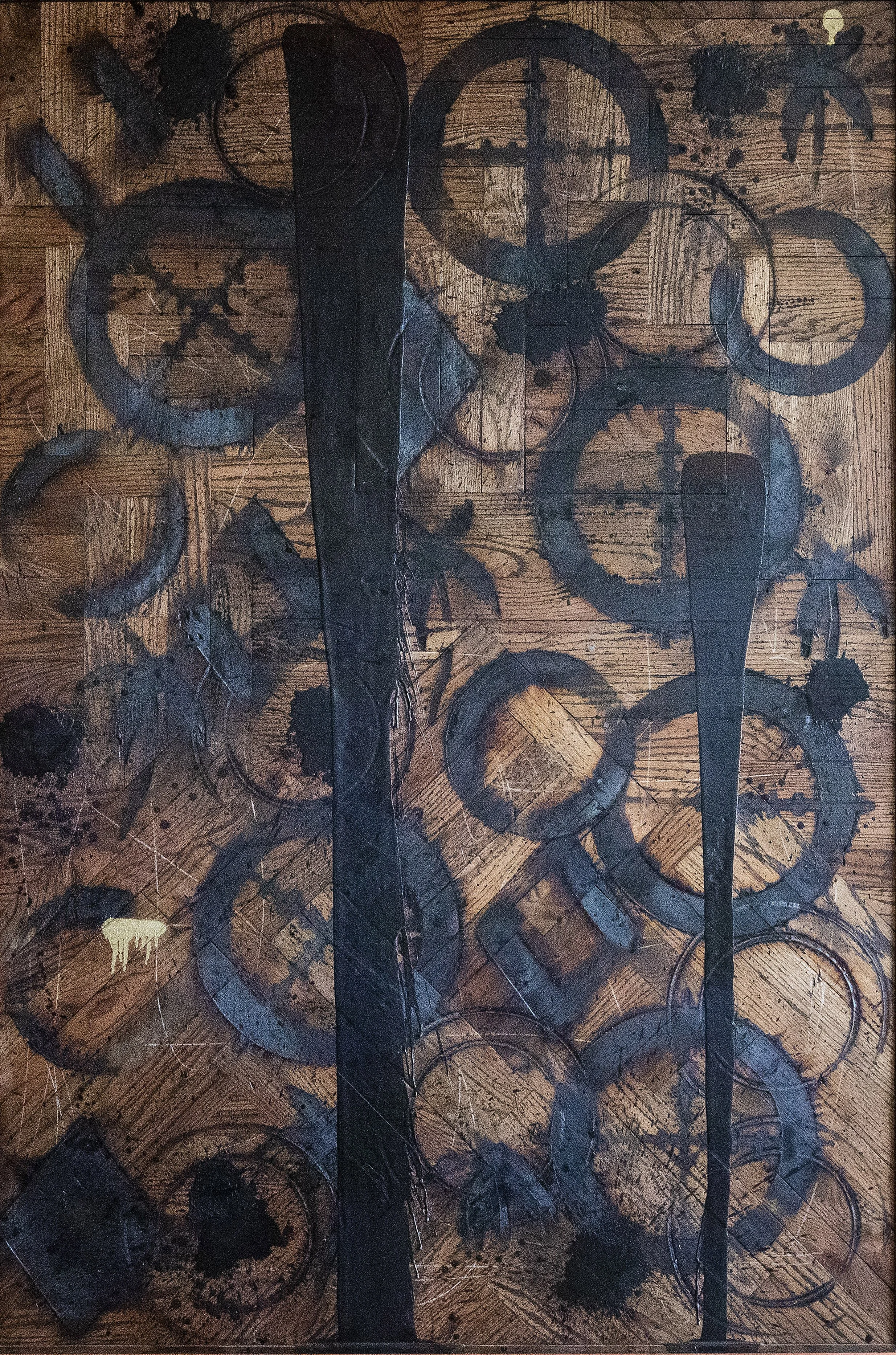
Black soap, wax and spray enamel on branded red flooring
71.875 x 47.875 in
Seascape “The Devil and the Deep Blue Sea”
2021
Oil on linen
95.875 x 157.75 in
Rashid Johnson (b. 1977, Chicago) is an artist who works in a wide range of everyday materials, including wax, wood, steel, brass, shea butter, ceramic tile and found objects such as books, records, VHS tapes, live plants and CB radios. Johnson first received critical attention at the young age of 24 when he was included in a Thelma Golden curated exhibition at the Studio Museum in Harlem. His work has since been exhibited around the world and is held in collections of many leading art museums. He is known for combining various science with black history so that his materials, which are formally independent, are augmented by their relation to black history.
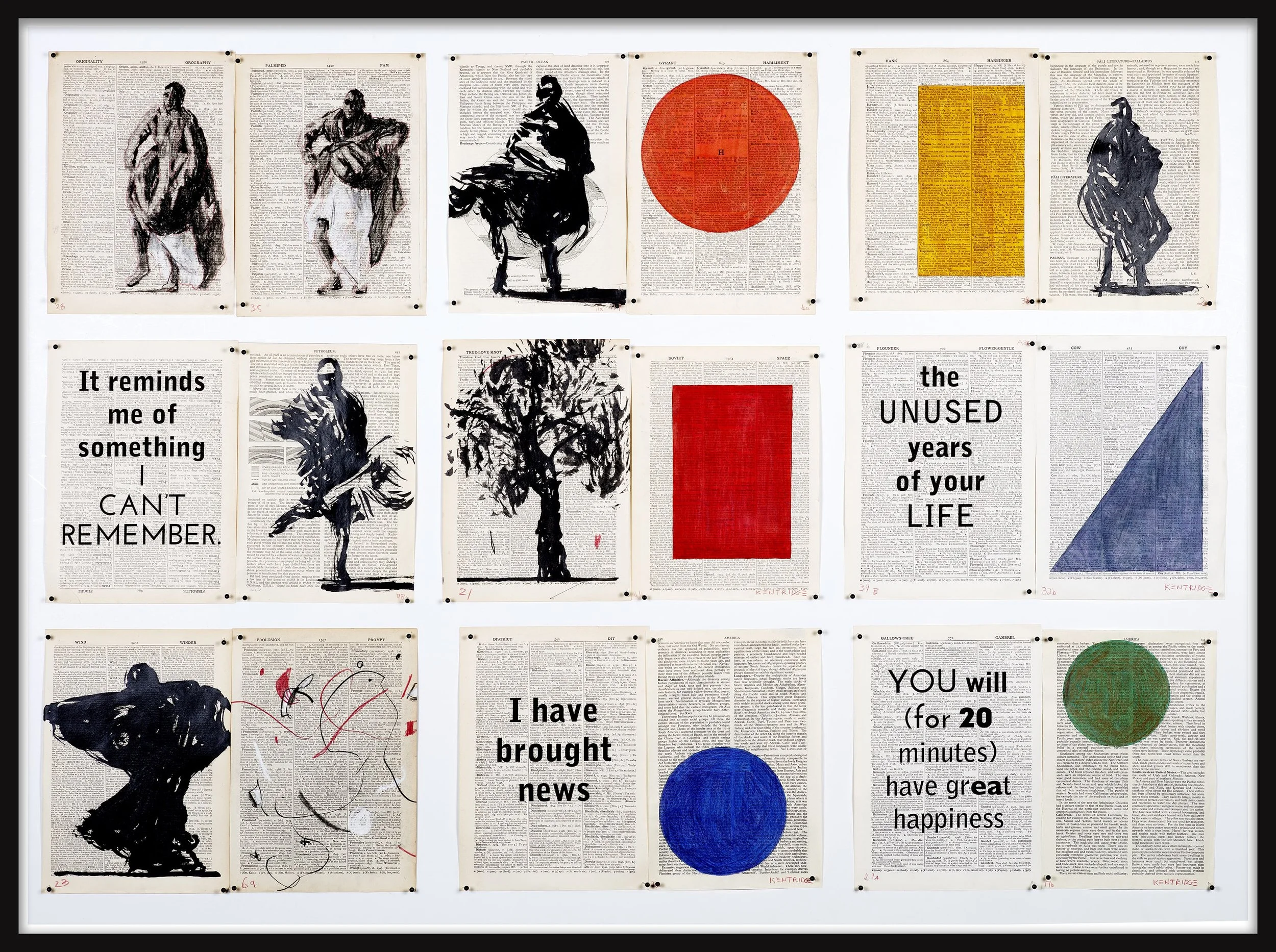
Drawing for Waiting for the Sybil (I have brought news)
2020
Indian ink, pencil and charcoal drawings on found pages
38.25 x 51.625 in
Drawing for 'Wozzeck Opera'
2017
Charcoal on paper
52.75 x 68.0 in
William Kentridge was born in 1955 in Johannesburg, South Africa where he currently lives and works. Often drawing from socio-political conditions in post-apartheid South Africa, William Kentridge’s work takes on a form that is expressionist in nature. For Kentridge, the process of recording history is constructed from reconfigured fragments to arrive at a provisional understanding of the past—this act of recording, dismembering and reordering crosses over into an essential activity of the studio. His work spans a diverse range of artistic media such as drawing, performance, film, printmaking, sculpture and painting. Kentridge has also directed a number of acclaimed operas and theatrical productions.
Wer jetzt kein Haus mehr hat, baut sich keines mehr (Who Has No House Now, Will Never Build One)
2018–2019
Emulsion, oil, acrylic and shellac on canvas
74.8125 x 110.25 in
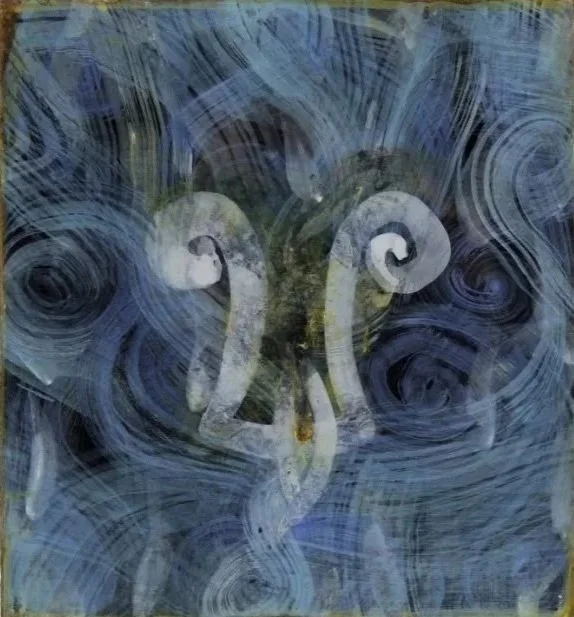
This piece takes its name from a passage by the German poet, Rainer Maria Rilke. In the 1960s, a teenage Kiefer had his first encounter with Rilke’s words when he discovered his monograph on the French sculptor Auguste Rodin. The phrase “Who Has No House Now, Will Never Build One” comes from the poem Autumn Day (1902), in which Rilke uses the motif of autumn to explore the melancholy of life’s transience and the seasons’ broad symbolism. In the centre of the painting, the faint structure of a door frame alludes to the house that may never be built before winter arrives. Rilke’s lament on the passage of time and the changing seasons drawing us closer to the year’s end is particularly resonate for Kiefer, whose art frequently considers the natural cycle of death and new life, endings and beginnings. In this painting, Kiefer’s autumnal palette erupts from the surface of the canvas in heady strokes that are at once sumptuous and beautiful while on the verge of decay, paving the way for winter and the renewal of spring.
This translation is by Edward Snow 1991:
Autumn Day (Herbsttag)
Lord: it is time. The summer was immense.
Lay your long shadows on the sundials,
and on the meadows let the winds go free.
Command the last fruits to be full;
give them just two more southern days,
urge them on to completion and chase
the last sweetness into the heavy wine.
Who has no house now, will never build one.
Who is alone now, will long remain so,
will stay awake, read, write long letters
and will wander restlessly up and down
the tree-lines streets, when the leaves are drifting.
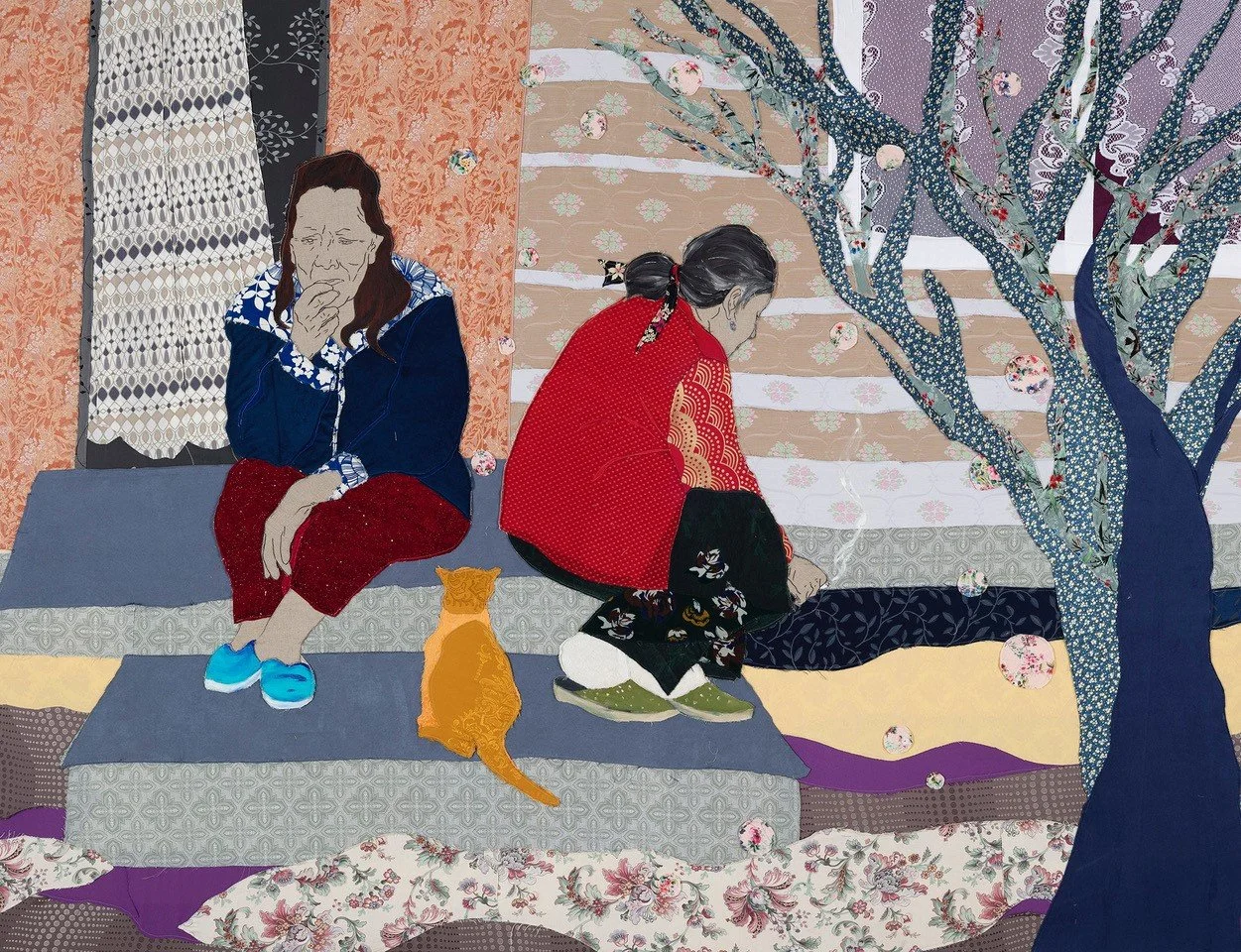
Gondolinen (Thinking)
2022
Patchwork and acrylic paint on stretcher
78.75 x 102.25 in
The work of Romani artist, educator, and activist Małgorzata Mirga-Tas (b. 1978, Zakopane) addresses anti-Roma stereotypes and engages in building an affirmative iconography of Roma communities. Her work depicts everyday life: relationships, alliances and shared activities. Mirga-Tas’s vibrant textile collages are created from materials and fabrics collected from family and friends, which imbues them with a life of their own and a corresponding immediacy. Patchworks made of curtains, jewelry, shirts, and sheets, are sewn together to form so-called 'microcarriers' of history, just as resulting images revise macro perspectives.
Mirga-Tas’s portrayals take the perspective of 'minority feminism', which consciously advocates for women's strength while acknowledging the artist's cultural roots. Mirga-Tas was the official Polish representative at the 59th Venice Biennale in 2022–the first Roma artist to represent any country. Her vibrant works offer a rare opportunity to see the Roma on their own terms, both as a contemporary community and as a people with a rich heritage.
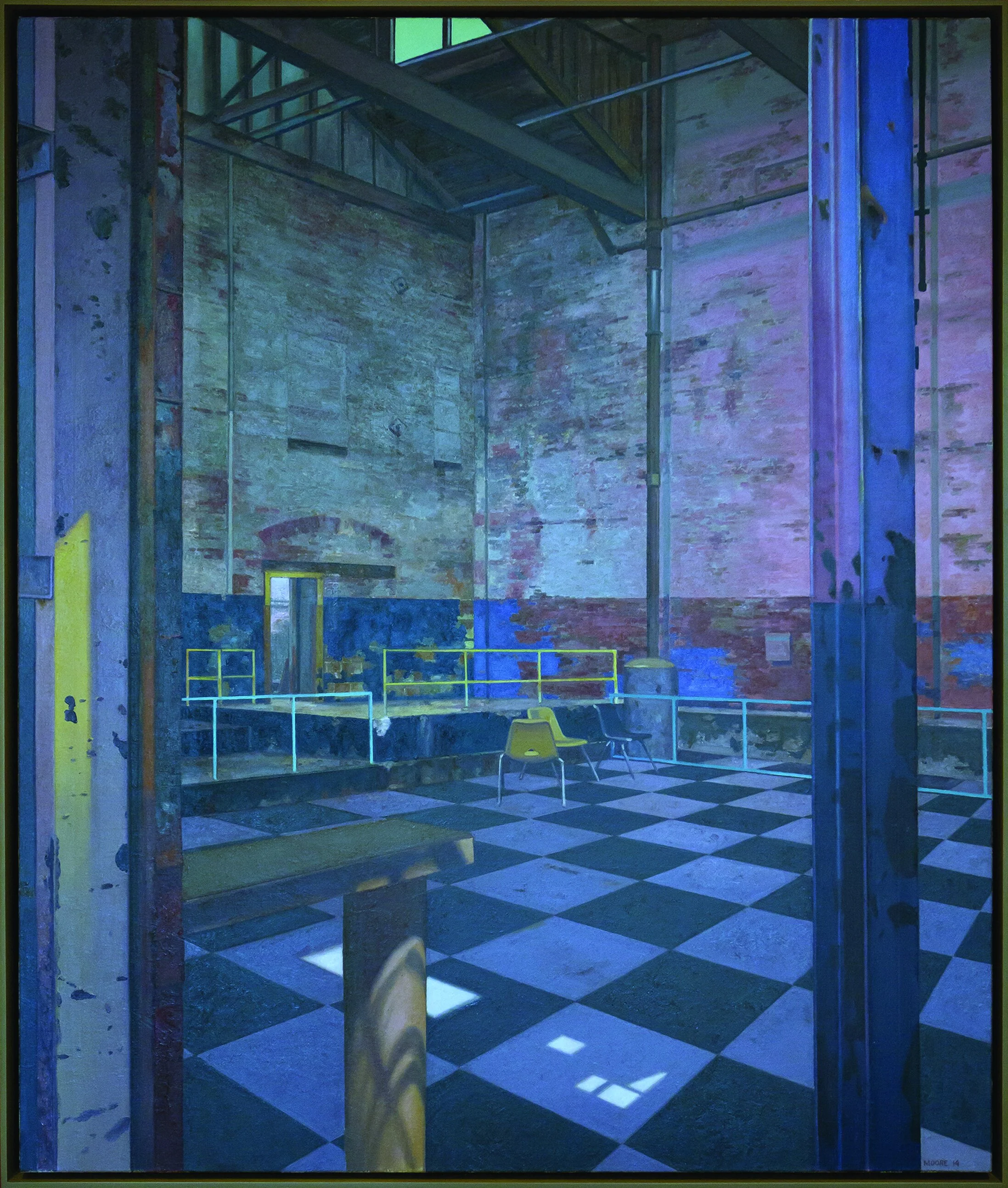
Dance Floor
2014
Oil on linen
60 x 50.25 in
John Moore (b. 1941, St. Louis) is an American contemporary realist painter whose work explores studio interiors, urban architecture and in his most celebrated work, the post-industrial landscape. While his paintings evoke a sense of realism, Moore’s masterful surfaces upon close inspection do not concede to the rigid glossy façade of photorealism, instead maintaining a uniquely felt touch. Using a variety of detailed brushwork, the surfaces are built up in luminous layers of contrasting hues.
The scenes presented in his work further subvert true realism, though based off of en plein air sketches, photographs and observational study in his studio. Moore reimagines each perspective by combining disparate elements from his observations of various sites, re-rendering architecture and the landscape to suit his sophisticated compositions.
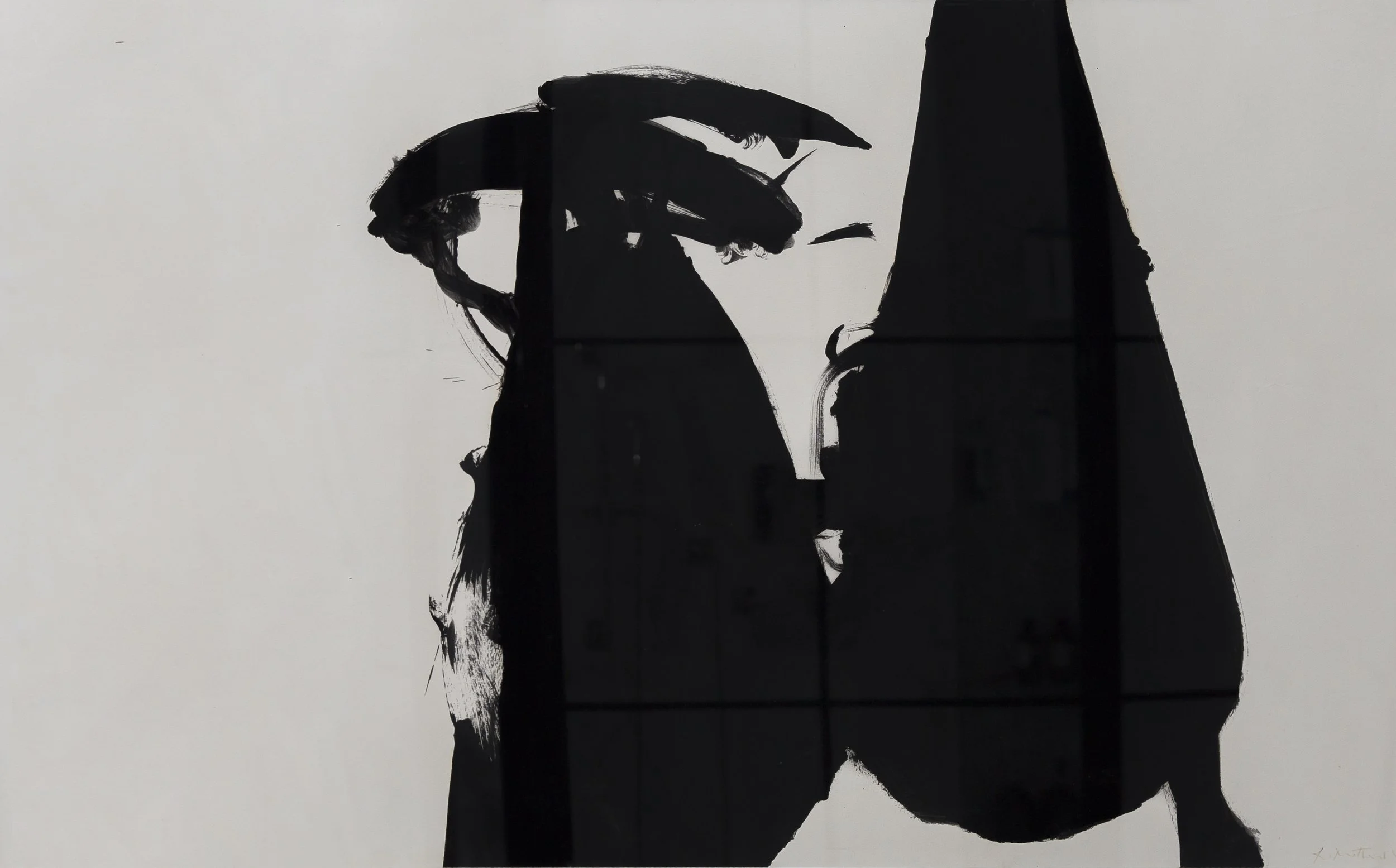
Untitled
1960
Gouache on paper mounted on canvas
35 × 49 in
Country Life No 1
1967
Acrylic and pasted papers on paper
30 × 22 in
Robert Motherwell (1915–1991) was born in Aberdeen, Washington, and died in Provincetown, Massachusetts. He was an American painter, printmaker and editor. He was one of the youngest of the New York School (a phrase he coined), which also included Philip Guston, Willem de Kooning, Jackson Pollock and Mark Rothko. He was a major figure in the Abstract Expressionist art movement, well known for both his gestural “Elegies” series, which employed a limited palate and bold shapes, and his “Open” series of fragmentary rectangles, pioneering examples of conceptual abstraction.
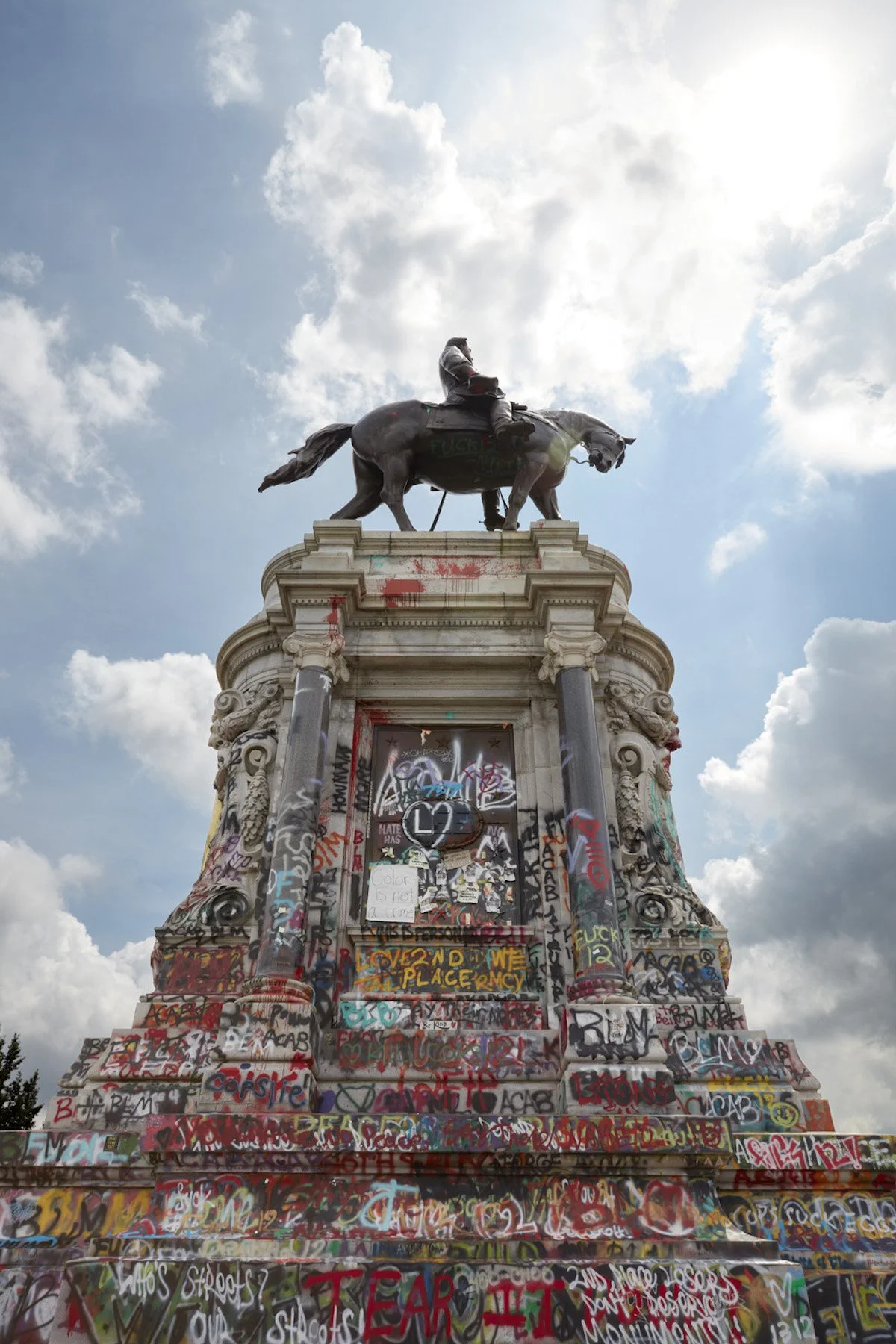
monument/monumental
2020
7 pigment prints
67 × 45.125 in
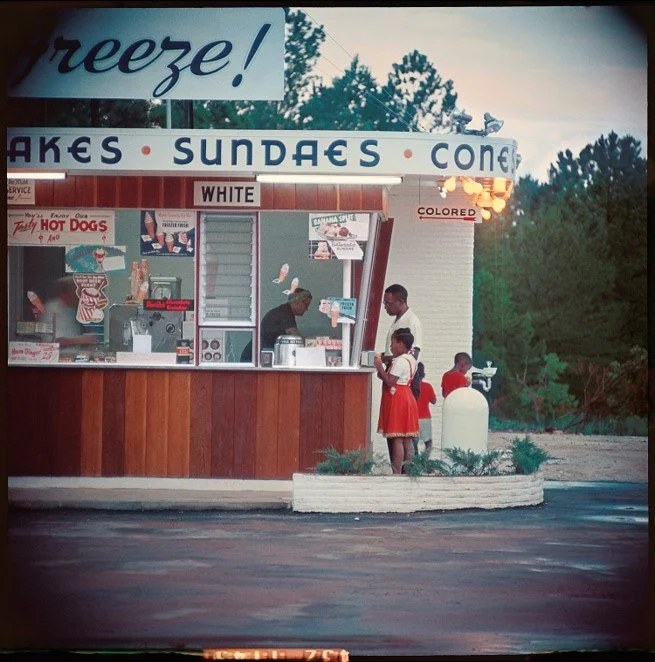
Untitled, Shady Grove, Alabama
1956
Archival pigment print
50 × 50 in
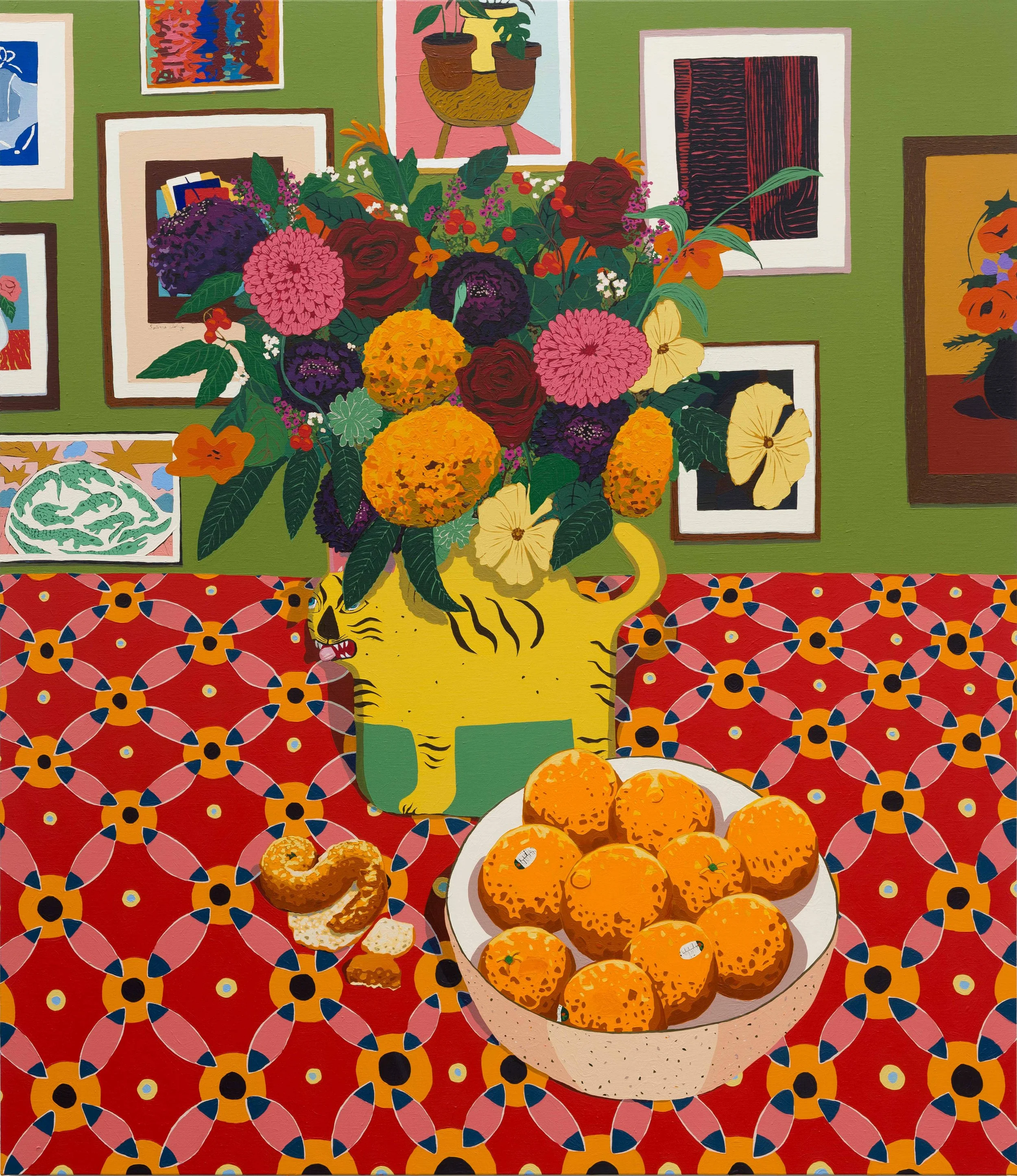
Tiger Vase
2023
Acrylic on linen
74 × 64 in
Hilary Pecis (b. 1979, Fullerton, California) makes paintings and drawings in which tableaus rich with interlocking fields of saturated color, geometric patterning, and bold linework provide views of sun-drenched domestic still lifes and landscape environments. Books crowding a coffee table, the remains of a dinner party, and terrains lush with Southern California succulents make frequent appearances in her work; these meticulously arranged interiors and vibrantly rendered exteriors amount to an overarching portrait of the self that identifies objects and locations as signifiers for human characteristics. Pecis combines distorted perspectives and surprising juxtapositions of hue, placing her work in dialogue with modernist art historical movements like Fauvism in which subjective and analytical tendencies are synthesized. At the same time, her interest in images sourced from her personal experience allows her to transform recognizable mise-en-scènes into vivid explorations that celebrate the quiet moments of everyday life.
Our Ideas #3 (19/36)
2018
Silkscreen ink on mylar
40.375 x 31.375 in
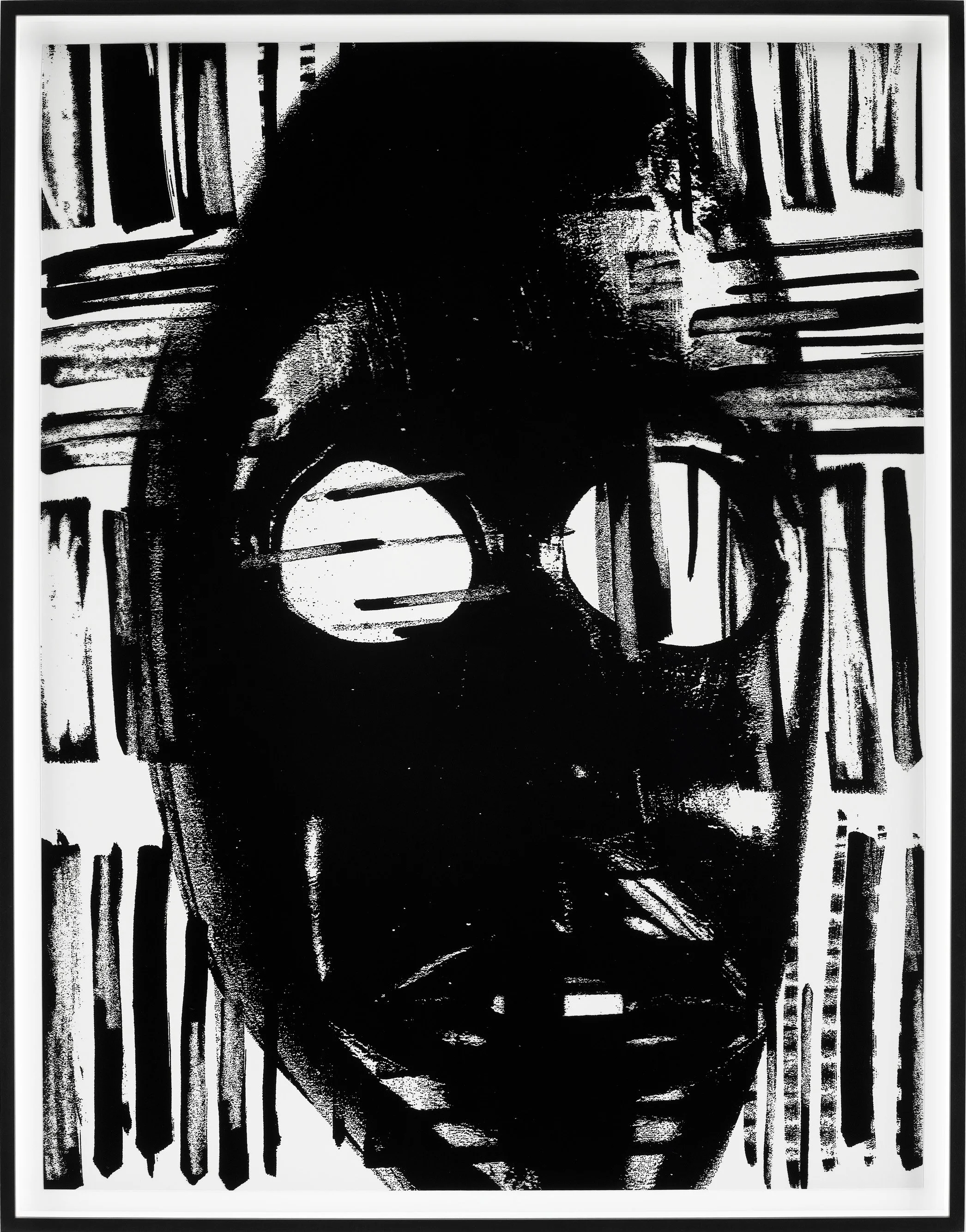
Adam Pendleton (b. 1984) was born in Richmond, Virginia, to a schoolteacher who loved books and a contractor who played jazz music in his spare time. Growing up, Pendleton worked his way through his mother’s library reading books by Audre Lord, Toni Morrison and Adrienne Rich. He developed an appreciation for language and theory that has directly informed his artwork. As a teenager, Pendleton spent hours studying art books and painting in his parents’ basement. He made pilgrimages to New York City galleries and museums alone and occasionally with his father.
When he turned 18, he moved to New York to become an artist. His father drove him and some of his paintings in the family’s van. He sent unsolicited slides of his work to galleries and one day walked into Gallery 128 on the Lower East Side of Manhattan with a painting under his arm. The owner, Kazuco Miyamoto, who also assisted conceptual artist, Sol LeWitt, put the work in her summer group show. When LeWitt stopped by the gallery to meet with Miyamoto, he saw Pendleton’s work. Impressed, he traded one of his gouaches for the painting. The following year, Pendleton developed a theoretical framework called Black Dada, which continues to provide the foundation for his practice today.
Though he used color in his early work, Pendleton has now limited his palette to black and white—not to connote racial categories but rather because he began to find color distracting. Working slowly and in ongoing series, he usually completes no more than 12 paintings a year.
Composition
1983
Acrylic on paper
27.5 x 38.5 in
Sigmar Polke (1941–2010) was born in Oels, Silesia, (now Oleśnica, Poland)—the seventh of eight siblings—and died in Cologne, Germany. Forced to leave in 1945, during the expulsion of Germans from Silesia, the family relocated to East Germany. When Polke was 12, they escaped to the West on a train, where he feigned sleep to deflect attention from the authorities.
His father was an architect and the family had been affluent, but they left everything behind when immigrating, trading comfort for freedom. The dislocation was jarring for young Sigmar, who began spending his free time in Dusseldorf’s galleries and museums, and soon decided to become an artist. He landed a job at a stained-glass factory, where he worked until he was admitted to the Kunstakademie Düsseldorf in 1961. It was an exciting time to study at the Academy. Joseph Beuys, Dieter Roth and Günther Uecker were professors, and fellow students included Gerhard Richter and Konrad Lueg with whom Polke formed the Capitalist Realism painting movement. A tongue-in-cheek provocation, the young artists’ concept alluded to both American Pop art and German Socialist Realism. Polke made paintings of men’s socks and sausages, among other proletarian goods, as well as of newspaper and magazine photographs.
Uninterested in a traditional career path, however, he stopped painting for much of the 1970s. He lived in a commune for a while, and travelled the world, experimenting with psychedelic drugs like mushrooms and LSD. He constantly took photographs, and in his typically irreverent way, often interfered with the resulting prints; folding, applying radioactive chemicals and drawing or painting on them.
Polke returned to painting in the 1980s, continuing his exploratory approach. The artist made little distinction between media, not only painting on photographs and paper, but experimenting with an alchemist’s array of materials from arsenic to jade to snail mucus. Polke continued to sample images too.
Pond 8
1976
Oil on linen
60 x 60 in
Warren Rohrer (1927–1995) was born in Lancaster County, Pennsylvania, and became one of Philadelphia’s leading abstract painters in the late 20th century. Coming from a Lancaster Mennonite upbringing, he strayed from conventional professional paths of becoming a farmer or minister when he began to pursue art and art education. Rohrer quickly embedded himself in the national contemporary art scene and would go on to teach for 25 years at the Philadelphia College of Art (now the University of the Arts).
The Gatherer
2014
Oil on aluminum
110 x 213.25 in
Bridge
1970
Acrylic on canvas
108 × 72 in
Doric 9.19.19
2019
Pastel on paper
40 × 60 in
Doric 10.2.19
2019
Pastel on paper
40 × 60 in
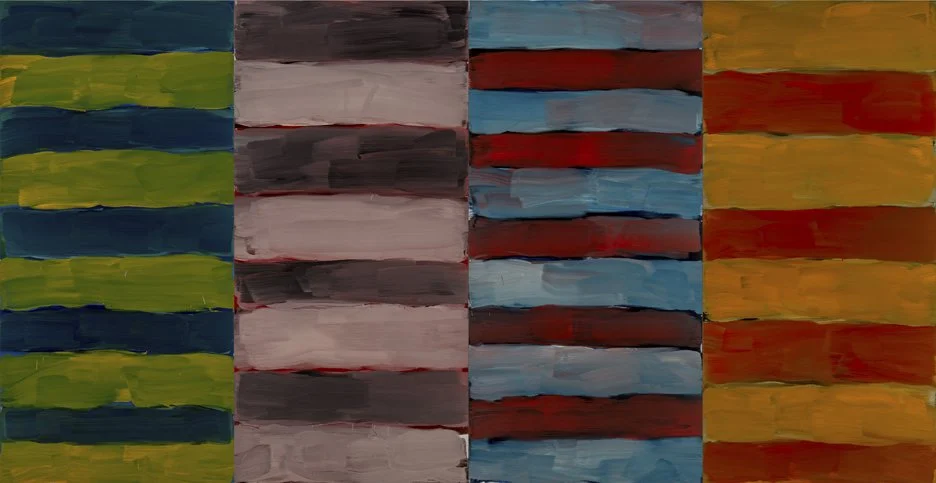
Sean Scully (b. 1945, Dublin, Ireland) is an Irish-born American-based painter and printmaker who has twice been named a Turner Prize nominee. His work is collected in major museums worldwide. Scully's paintings are abstract and often made up of a number of panels. He paints in oils, sometimes laying the paint on quite thick to create textured surfaces. He frequently employs rectangular shapes in his compositions that he refers to as bricks. These visual building blocks were originally inspired by the Mayan ruins and the megaliths and stone walls of the artist’s native Ireland—examples of humankind’s enduring accomplishments, interconnectedness and our relationship to our ever-present past and future.
Sault Ste. Marie, Ontario
August 13, 1974
Chromogenic color print
20 × 24 in
21st and Spruce Streets, Philadelphia, Pennsylvania
June 21, 1974
Chromogenic color print
20 × 24 in
Church and 2nd Streets, Easton, Pennsylvania
June 20, 1974
Chromogenic color print
20 × 24 in
U.S. 97, South of Klamath Falls, Oregon
July 21, 1973
Chromogenic color print
20 × 24 in
Pine Street, Seattle, Washington
August 27, 1974
Chromogenic color print
20 × 24 in
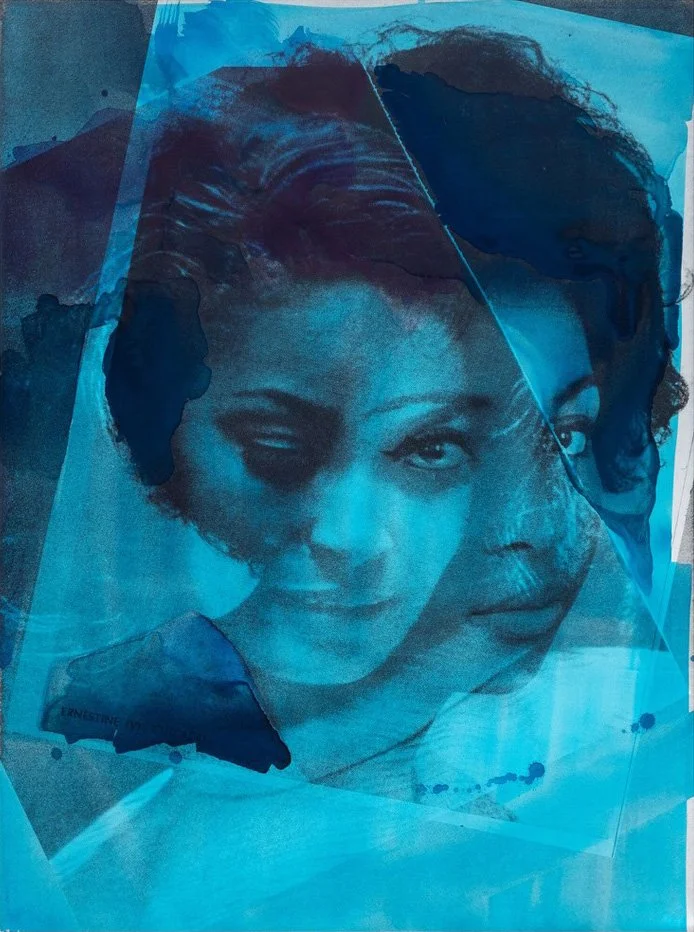
Special Character #1
2019
Ink and screenprint on gessoed fiberglass
67 × 50 in
Collide
2019
Ink and screenprint on gessoed fiberglass
67 × 50 in
Lorna Simpson (b. 1960) was born and raised in Brooklyn, New York, to parents who shared her love of art. Simpson started taking photographs before high school, after mailing in coupons from the backs of Kleenex boxes to get a free Polaroid camera. This first passion stuck with her through her time studying at the School of Visual Arts, where she majored in painting and photography. After pursuing an MFA at the University of California, she began exploring conceptual interweaving of text and photography.
Simpson’s later work was informed by found images, such as photos and text from old Jet and Ebony magazines found in her grandparent’s home. Simpson’s work also explores the colors blue, black and the cultural concept of “blue-black,” a descriptive term used primarily by African Americans to describe dark-skinned people. Simpson found inspiration in the works of poet Robin Coste Lewis, who shares her interest in the intersection of color theory and racial and cultural identity. Simpson included Coste’s poem about the Arctic on the wall of one of her shows.
Simpson continued this theme of the Arctic for several years, invoking a harsh place that is inhospitable to human life. The already dangerous environment is emphasized by her dramatic palette—deep blues and blacks—as if it is night. Through her works, Simpson expresses her belief that we are currently living in a dark period in American history, and questions how to survive.
Past Presence 057
2014
Gelatin silver print
71.75 × 60 in
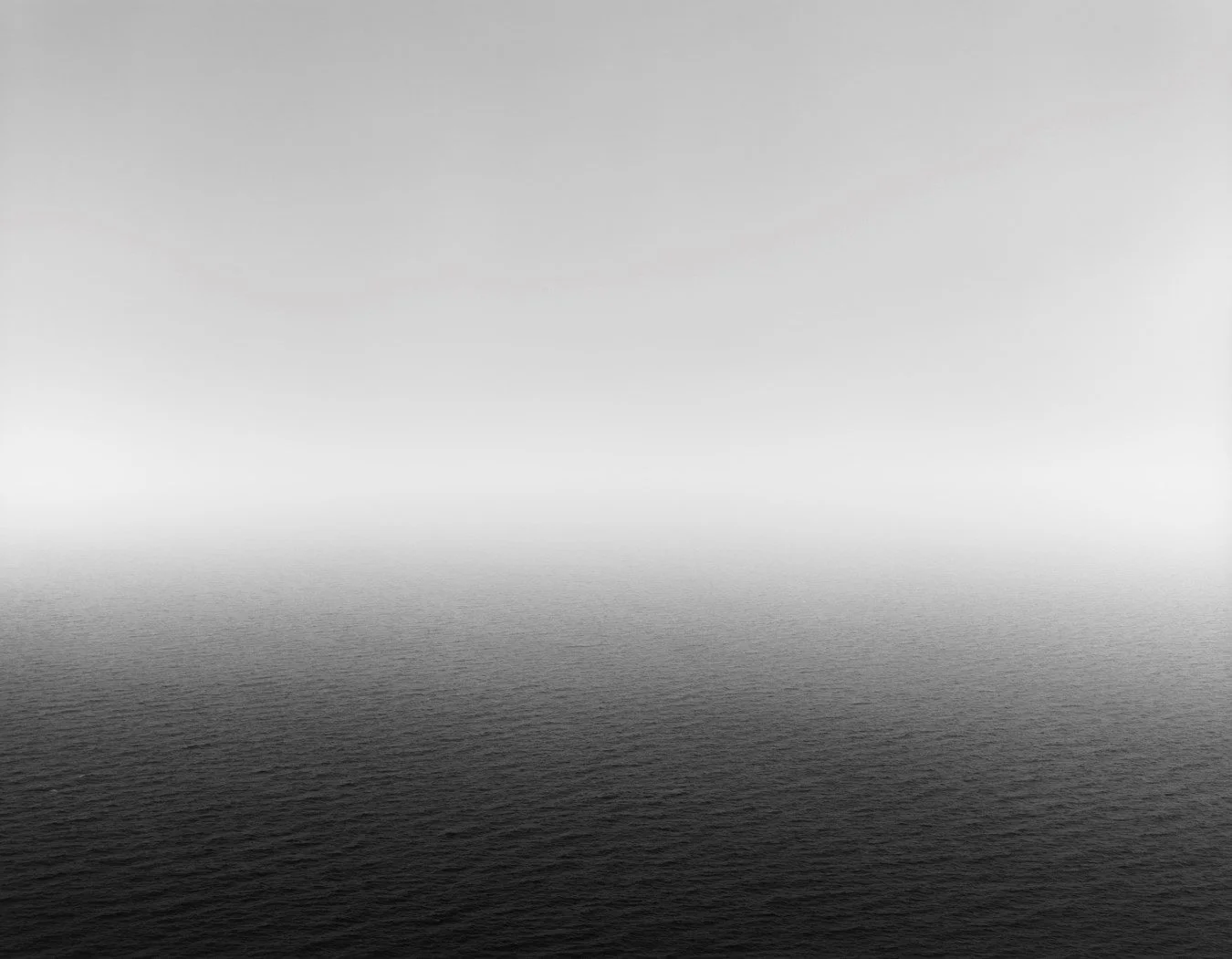
Tasman Sea, Table Cape
2016
Gelatin silver print
60.125 × 71.75 in
Wapiti
2006
Gelatin silver print
47 × 83 in
Hiroshi Sugimoto (b. 1948, Tokyo, Japan) is a Japanese photographer currently dividing his time between Tokyo and New York City. His catalogue is made up of a number of series, each having a distinct theme and similar attributes. Sugimoto photographed this Seascapes series in locations all over the world using a large format camera and often very long exposures (in some cases up to three hours). He is compelled by the visual juxtaposition of the two essential life-giving elements of air and water—always forming the composition so their intersection bifurcates the pictorial plane.
8 Greenwood Place (1988-1993)
2021
Oil on canvas
72 × 84 in
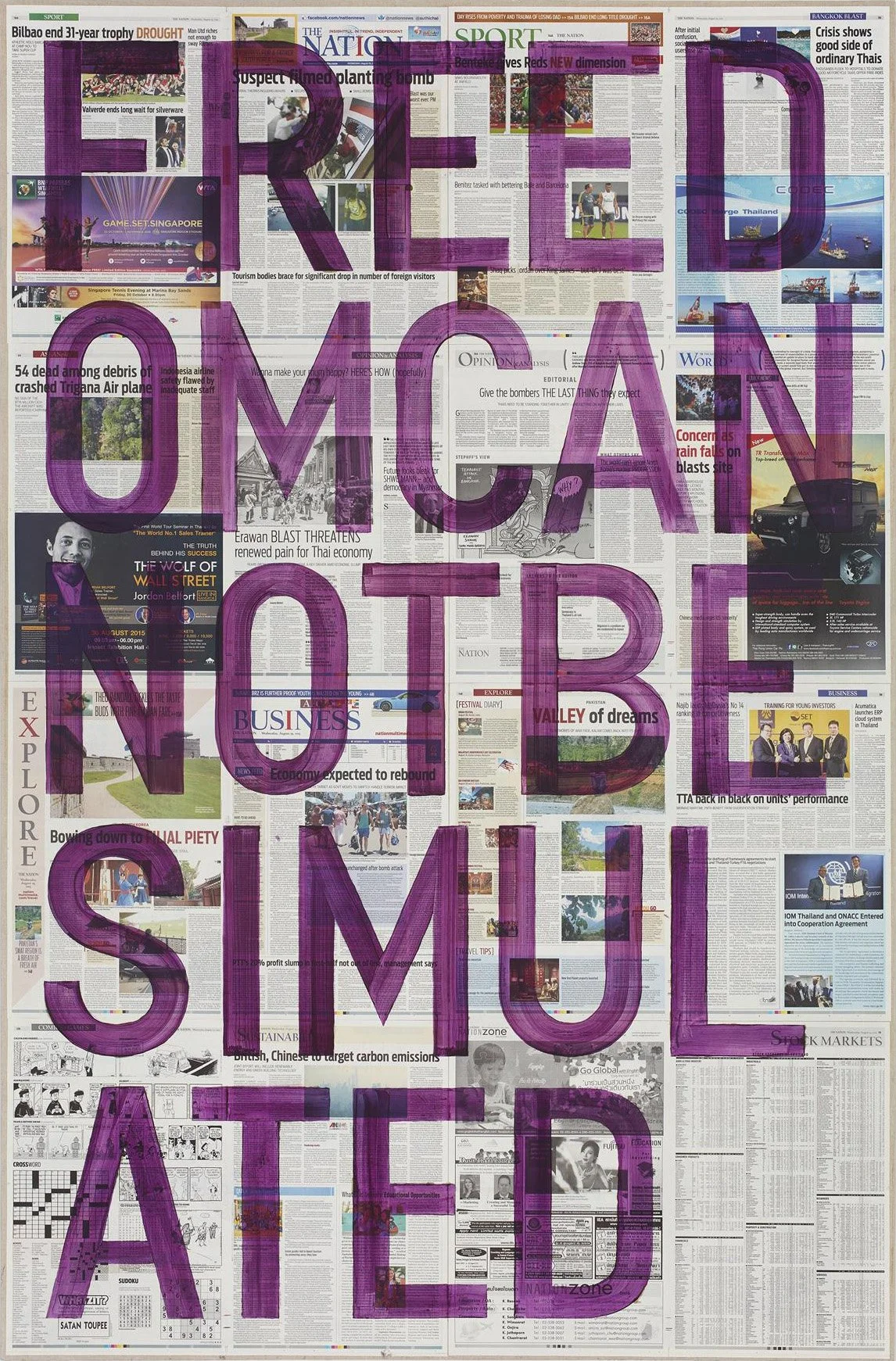
untitled (freedom cannot be simulated)
August 19, 2025
Acrylic and newspaper on linen
86.375 x 56.25 in
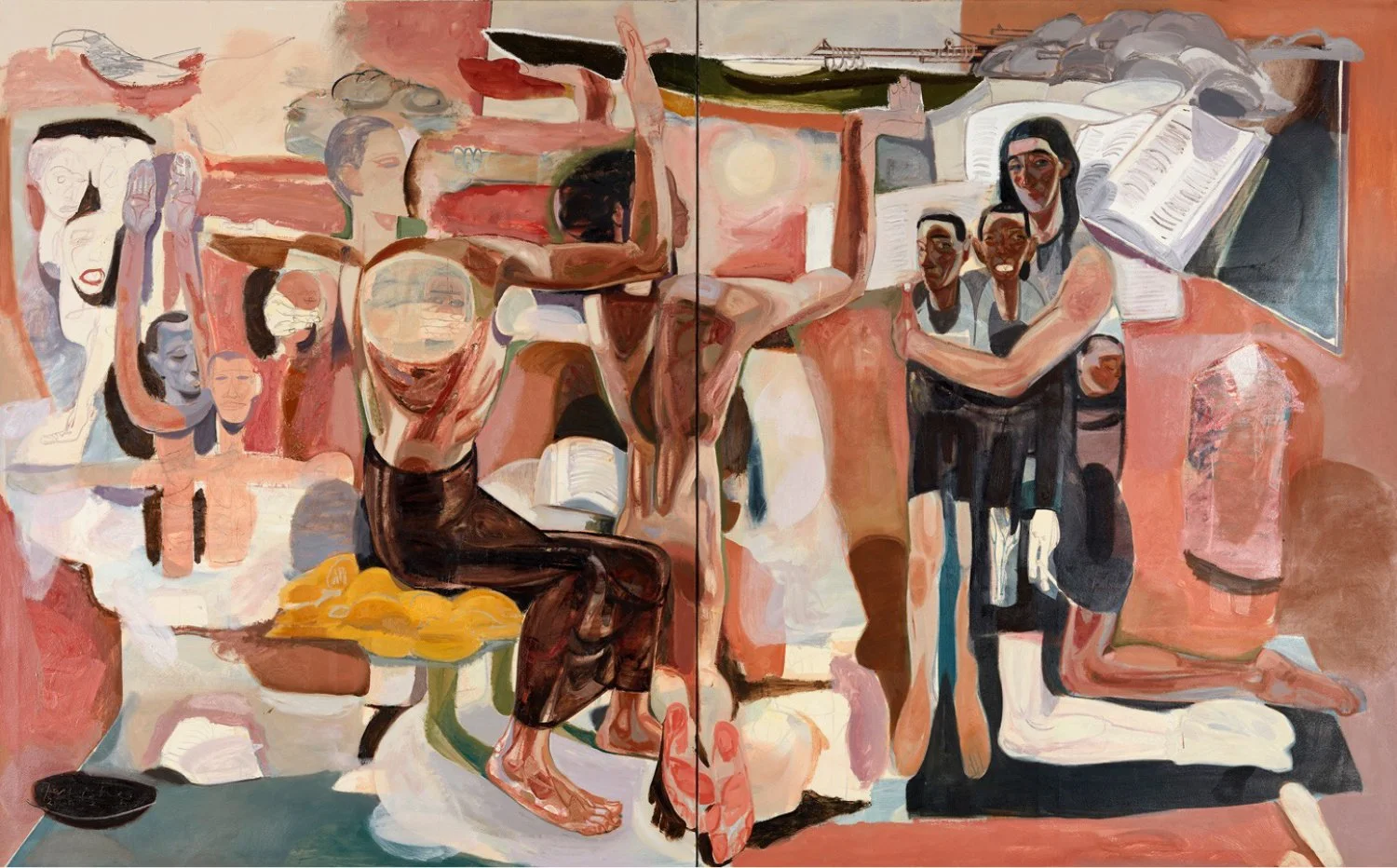
Chasing After the Wind
2020
Oil on canvas
98.425 × 157.48 in
American Monuments I and II
2015-2016
Gelatin silver print
45 x 35 in
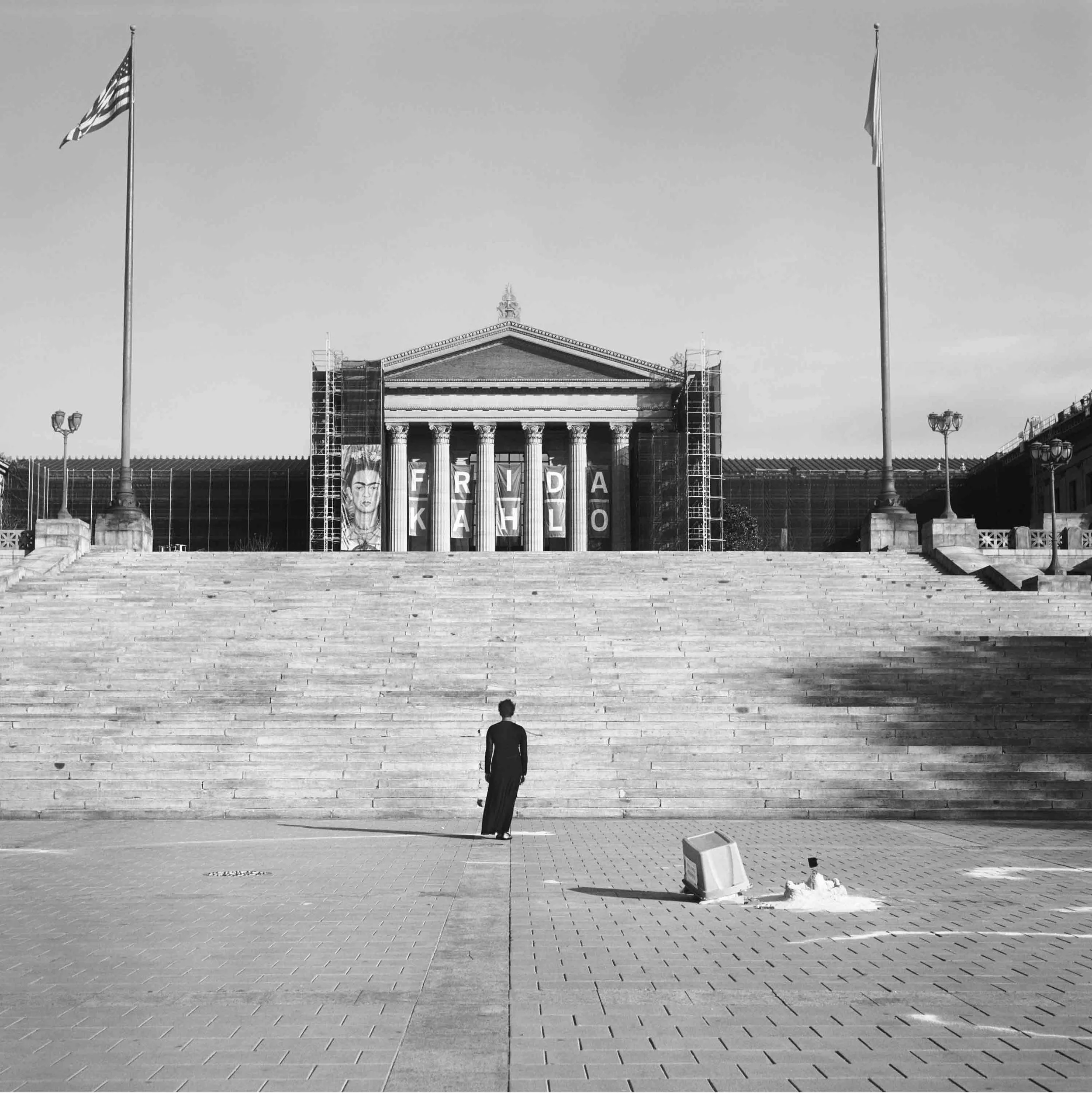
Philadelphia Museum of Art
2006
Digital c-print
71.5 x 59.5 in
And 22 Million Very Tired and Very Angry People (13/15)
1991
Archival inkjet prints
30 × 25 in
Inkjet Print 5237
2008
Inkjet print
40 × 59 in
James Welling (b. 1951, Hartford, Connecticut) has been questioning the norms of representation since the 1970s. His work centers on an exploration of photography, shuffling the elemental components of the medium to produce a distinctly uncompromising body of work. He is also intensely interested in cultural and personal ideas of memory in his work. He is known for his peripatetic practice, using diverse strategies to produce works that are at times representational, at times abstract, and often, paradoxically, both. In opening up the medium of photography for experimentation, Welling’s practice has influenced an entire generation of artists and photographers.
Welling’s fifth solo show at David Zwirner Gallery featured photographs documenting Philip Johnson's iconic “Glass House,” built in 1949, in New Canaan, Connecticut. Taken over the course of three years (2006–2009), these photographs were made using a digital camera, and the resulting images capture the architectural features of Johnson's 47-acre compound.
In a statement on “Glass House,” Welling elaborates on the physical and conceptual properties of his interventions: “Although the “Glass House” is symmetrical (the front is the same as the back), I prefer a frontal view because you can see through the house to the landscape directly west. This is the aspect of the house that is perhaps most fascinating to me. This big glass box, plunked down in the Connecticut landscape, seems like a conceptual sculpture, a gigantic lens in the landscape. When I realized I could make the glass red or add reflections to the face of this supposedly transparent house, my project became a laboratory for ideas about transparency, reflectivity, and color.”
Welling received his BFA and MFA from the California Institute of the Arts in Valencia, California.
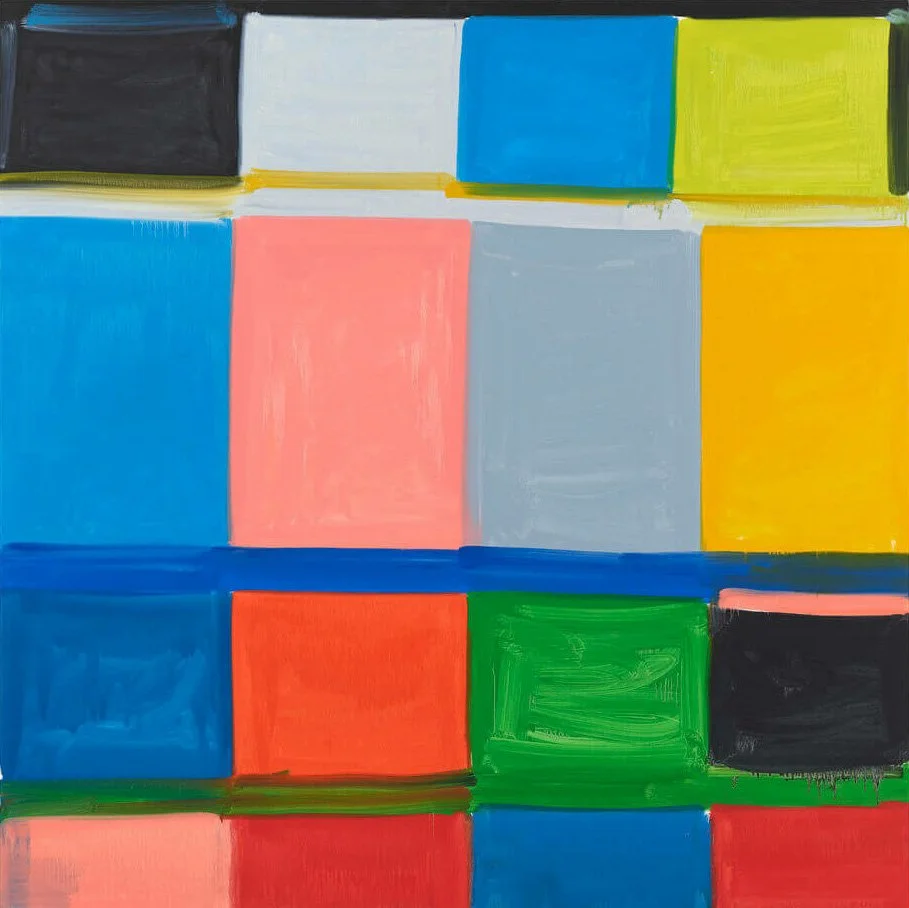
Spoonful
2018
Oil on linen
80 × 80 in